8 Ways to Optimize for AEO in 2026
At a recent WILMA meeting, a room full of industry marketers spent close to an hour comparing notes on how AI search is changing the way buyers find and choose vendors. Small teams. Lean budgets. Niche markets. All of us working the same problem in real time.
The conversation was candid and a little unglamorous, and that’s what made it useful. None of it was theory. It was a working playbook for Answer Engine Optimization (AEO). Here’s what to start doing now.
1. Treat every press release as an AI-citable asset
Stop treating a press release like a one-day news event. AEO engines pull from structured, authoritative documents for months after they go live, so write yours to be quoted.
Give it a clear summary up top. Break the body into short, declarative sentences and scannable bullets. Lead with facts and named sources instead of adjectives. PR Newswire and Business Wire have long been the default platforms, though pricing has pushed plenty of teams toward Notified, which scores your draft for AI readability and reports how often it gets cited in tools like ChatGPT. If your platform offers that scoring or citation tracking, use it, and check which models are actually quoting you. One release built this way beats three written as announcements.
2. Kill the self-serving "best providers" blog
Don’t publish a “Best [Your Category] Providers in 2026” post that ranks your own company first and pads the list with weak competitors you know you’ll beat. It’s transparent, and it doesn’t last. Brands that cast too wide a net to rank for everything have watched their AEO traffic fall off a cliff.
If you write a comparison piece, make it genuinely useful. Include the real competitors and be honest about where you fit. AI engines are getting good at spotting self-dealing content. Build your AEO authority on something you’d defend out loud.
3. Earn third-party mentions, because that's where AI looks
This is the most important shift on the list. By most estimates, the large majority of citations in AI answers, around 90% by some research, come from earned and third-party media rather than a brand’s own website.
The reason is simple. AI is trying to surface real-world-of-mouth. When a buyer asks ChatGPT, Claude, or another LLM “what’s the best billing tool for a warehouse,” it leans on Reddit, YouTube, LinkedIn, Quora, G2, and Gartner far more than on vendor blogs. So shift your effort there. Get reviewed on G2 and Capterra. Get quoted in industry roundups, and get real customers talking about you in public. Your owned content matters less than the trail of credible AEO signals pointing back to you.
4. Use Reddit to listen. Don't advertise there.
Don’t run ads or post thinly veiled promotions on Reddit. Communities spot it instantly, and you’ll burn budget and goodwill at the same time.
Lurk instead. Spend an hour a week reading the threads in your industry. Mine them for the language buyers actually use, and the pain points nobody’s solved yet, then feed that straight into your content and messaging. When you do engage, do it as a helpful expert answering a real question, never as a brand. And keep in mind that Reddit is a vocal minority. It’s qualitative insight, not a representative sample.
5. Make consultants and execs your distribution channel
The credible independent voice is the new influencer. Publish all your thought leadership on your own blog, and AI engines discount it as advertising. Get it into the open instead, through people your buyers already trust.
Partner with respected consultants who can answer real questions in community threads and guest posts. Back a senior leader in writing candidly about the industry, under their own name, on a platform like Substack or LinkedIn. What you’re after is third-party credibility. Content that lives where your buyers already are and carries a name that isn’t your logo.
7. Put an LLM to work on schema and content gaps
Two free tasks worth doing this week.
First, make your content readable to AI crawlers. When standard FAQ markup isn’t enough, have an LLM write structured schema for the page and drop it into a custom HTML block. Clean, machine-readable markup directly improves how AI engines parse and quote you.
Second, run a gap analysis. If a competitor’s sitemap is public, have an LLM crawl it and flag the topics they cover that you don’t. For a small team, that’s hours of competitive research compressed into minutes, plus a ready-made content roadmap.
8. Stop chasing rankings. Measure AI traffic instead.
AEO search results are personalized now. Cookies, IP address, search history, even what’s sitting in someone’s inbox all shape what they see. There’s no single “where do I rank” answer anymore, and an incognito window won’t give you a true AEO read either.
So stop spending energy on a ranking that doesn’t really exist. Measure what’s real. Google Search Console and Bing Webmaster Tools now report AI-driven traffic as its own category. Watch that number and tie your AEO work to it. It’s the closest thing to ground truth you’ll get.
The tools that came up
It helps to know what’s in other marketers’ stacks. For press releases, the room split between PR Newswire and Business Wire, the long-time defaults, and Notified, the cheaper option that now scores drafts for AI readability and tracks citations. The AI search testing happens across ChatGPT and Claude. For earned media and community, the names in play were Reddit, YouTube, LinkedIn, Quora, G2, Capterra, Gartner, and Substack. And for measurement, Google Search Console and Bing Webmaster Tools, both now breaking out AI traffic on their own.
Intent data was its own rabbit hole. ZoomInfo, HubSpot, Salesforce, Lead Forensics, and Seamless all came up, and that’s a topic big enough for its own post.
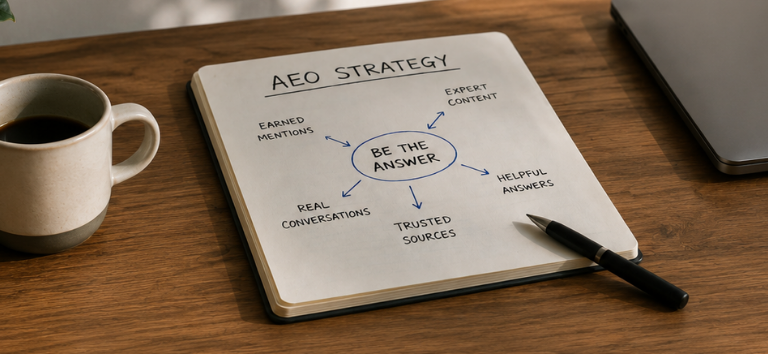
Here’s what ties all of this together. If your AEO strategy depends mostly on content you publish about yourself, you’re playing the old game. The new one is authority and distribution. Credible third-party signals, working in your favor, so AI engines have something worth citing.
That’s the work, and it’s exactly what we do at Virago. If you want a second set of eyes on where your brand actually shows up in AI search and across AEO, let’s talk.
FR8 Marketing Gurus
A podcast where freight, logistics, and supply chain leaders come to talk real marketing.